A monochromatic light is incident on a metallic plate having work function  . An electron, emitted normally to the plate from a point A with maximum kinetic energy, enters a constant magnetic field, perpendicular to the initial velocity of electron. The electron passes through a curve and hits back the plate at a point
  . The distance between
  and
and  is: (Given: The magnitude of charge of an electron is e and mass is m, h is Planck's constant and c is velocity of light. Take the magnetic field exists throughout the path of electron)
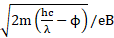
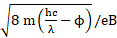
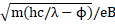

Text Solution
Verified by ExpertsB
To determine the distance between points  and
and  (where the electron re-enters the metallic plate), we first need to understand the electron's behavior in a magnetic field.
Maximum Kinetic Energy (KE): The energy of the emitted electron can be given by the photoelectric equation:
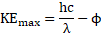
Here,  is the energy of the incident photons, and
  is the work function of the metal.
Momentum (p): The momentum of the electron is related to its kinetic energy by the equation:
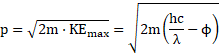
Path of Electron in Magnetic Field: When an electron moves perpendicularly through a magnetic field, it follows a circular path. The radius  of this path is given by:

where  is the charge of the electron, and
  is the magnetic field strength.
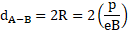
Distance Between  and
and  : Since the electron travels back to the plate, forming a complete semicircle, the distance between points
  and
and  is twice the radius of this circular path:
Substituting the expression for momentum, we find:
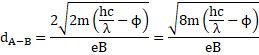
Therefore, the distance between  and
and  is
is  .
.
Prepare Smarter with CGP Edu
Get practice questions, solutions, and test series in one place.
Write a Review
Share your experience with this question and solution.
Commentary
Send your comment, doubt, correction, or feedback to admin.
Similar Questions
Explore conceptually related problems